


Peer-reviewed in Scientific Reports, 2025

Bloodwork that tells you where to act first.

SevenAge turns seven routine blood biomarkers into one clinically validated biological age — so your patients see the biggest drivers of future disease, years before standard panels flag a problem.

59,741
training samples
5 yrs
earlier risk signal
7
biomarkers, one number
A vial of blood with golden biomarker particles

Biological age

47.2

Chronological

40.0

+7.2 yrs — cardiometabolic strain detected

Built and validated with

ETH ZürichBumrungrad InternationalVitalLife Scientific WellnessNHANESUK BiobankNature · Scientific Reports

Different by design

Not another methylation clock.

Methylation clocks tell you how fast you've aged. SevenAge tells you which systems are driving it — and where a doctor should act first. It runs on the blood panel patients already get.

Methylation clocks

  • Specialised lab, weeks to result
  • Single aging score
  • Hard to act on clinically
  • USD 300–600+ per test

SevenAge

  • Standard blood draw, same-day result
  • Biological age + 7 biomarker drivers
  • Direct lever for every score
  • Affordable at population scale

Standard panels

  • ‘Normal’ vs ‘abnormal’ only
  • Misses preclinical risk
  • No single risk number
  • Doesn't prioritise interventions

“What if your bloodwork could do more than tell you whether you're normal or abnormal — and instead show you where to focus first?”

The science

A clinical clock, not a curiosity.

SevenAge was developed by KEYONIQ in collaboration with ETH Zürich, Bumrungrad International Hospital and VitalLife Scientific Wellness Center, and validated across three continents.

scientific reportsOriginal ResearchOpen Access
Published 10 December 2025 · Scientific Reports 15, Article 43538 (2025)

A sex-adjusted 7-biomarker clinical aging clock for translational preventative medicine

Meyer, Mejia, Molière, Wangprapa, Khunlertkit, Teekakirikul, Ewald & Viecelli

“A clinical aging clock based on routine blood biochemistry from 59,741 healthy samples. Based on only seven biomarkers, our clock accurately predicts self-reported and physician-annotated ICD health data, indicating an increased hazard ratio — and is robust even in the presence of acute infections.”

Read the full paper on nature.com
59,741
samples in training cohort
PCC ≈ 0.9
vs. 34-biomarker reference
3 cohorts
SE Asia · NHANES · UK Biobank
5,454
accesses · 25 Altmetric

7 biomarkers, full-body signal

HbA1c, albumin, creatinine, ALT, HDL, triglycerides, RDW — distilled from a 34-biomarker model with PCC ≈ 0.9.

5-year early warning

People who later developed type 2 diabetes or CKD already showed elevated age acceleration up to 5 years before diagnosis — even with non-diabetic HbA1c.

Robust to infection

Stable during acute flu and COVID-19. Reflects long-term inflammatory burden, not short-term spikes.

Sensitive to inflammaging

Age acceleration rises monotonically with CRP quantiles, capturing the silent inflammatory load that drives chronic disease.

Externally validated

Trained on 59,741 Southeast Asian samples; externally validated in NHANES (US) and UK Biobank (European-ancestry).

Peer-reviewed

Published in Nature's Scientific Reports (2025) — independently scrutinised, not a marketing whitepaper.

Ages 20–806 continents in training & validationWorks with diagnosed diseaseDesigned for repeat testing
The SevenAge Report

One number. Seven drivers. A plan you can act on Monday.

Every result becomes a clinical conversation — biological age, the biomarkers driving it, and prioritised next steps your doctor can prescribe today.

SevenAge Biological Age Report — cover

Cover

Personalised, peer-reviewed Biological Age Report

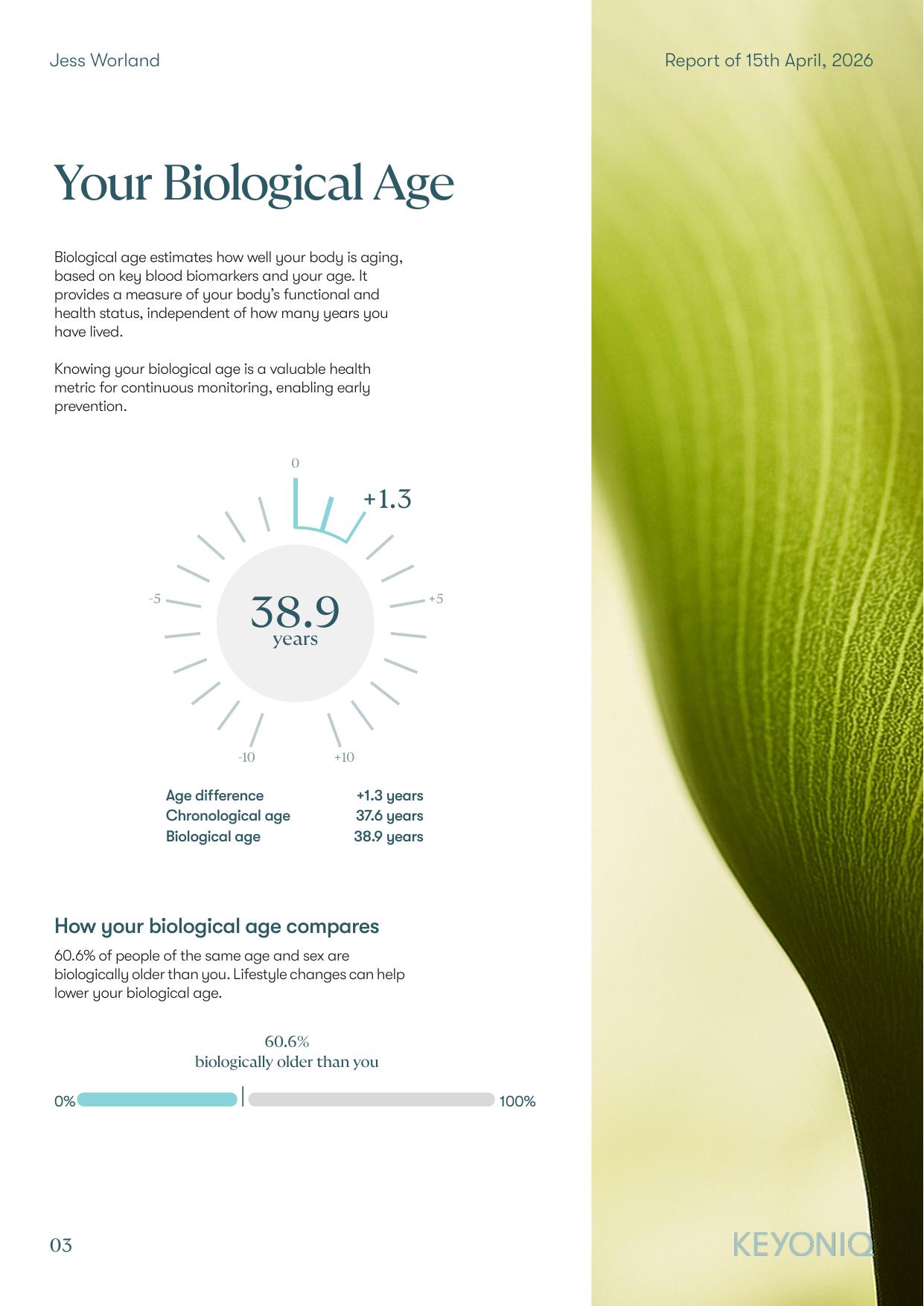
Headline number

47.2

Biological age

40.0

Chronological

+7.2 yrs · cardiometabolic strain detected

SevenAge laboratory results page — seven biomarkers against sex-adjusted reference ranges

Lab results

7 biomarkers vs. sex-adjusted reference

Top driver biomarkers

  • HbA1c5.9% · elevated
  • Triglycerides2.1 mmol/L · elevated
  • ALT42 U/L · borderline

Doctor-led recommendations

The first three things to change.

Each report closes with a ranked, evidence-based action plan — written for the patient, usable by the clinician.

01

Tighten glycemic load

Fibre-first plates, post-meal walks, optional 14-day CGM to surface the worst-offending meals.

02

Re-balance lipids

Swap refined carbs for omega-3-rich proteins; re-test triglycerides and HDL at 12 weeks.

03

Protect the liver

Cap alcohol at ≤3 units/wk, audit hidden fructose, follow-up ALT + GGT in 90 days.

Re-test at 90 daysTrend line, not a single snapshotHand-off to your clinician

Case spotlights

Three patients. Three plans. One number.

Female, 23 — autoimmune & CKD history

Creatinine

118µmol/L

Reference range: 45 – 84 µmol/L

Protect kidneysCritical
+9 yrs
EARLY 20s

When a past kidney disease still shows

Female, 23 — autoimmune & CKD history

She does everything right: strict low-carb, high-protein, steroid-controlled autoimmune disease. SevenAge flags the long-standing creatinine, the genetic triglycerides, and — counter-intuitively — an HbA1c that may be too low for her muscle mass. Her doctor reframed the plan: protect kidney function, build muscle, sustain not restrict.


Female, 52 — post-menopausal

Triglycerides

0.9mmol/L

Reference range: < 1.7 mmol/L

Now optimalImproved
−5 yrs in 6 months
EARLY 50s

Lifestyle changes, measured in years

Female, 52 — post-menopausal

Baseline: biological age 57.2 (5 years ahead of chronological). Six months of fibre-first meals, CGM-guided carbs and post-meal walks. Triglycerides and ALT down, creatinine up (more muscle). Biological age now 52.0 — matching her real age.

Male, 38 — HIIT, weights, clean diet

HbA1c

5.8%

Reference range: < 5.4 %

Needs reductionElevated
+12 yrs
LATE 30s

When 'doing everything right' isn't enough

Male, 38 — HIIT, weights, clean diet

Hard training and disciplined nutrition, but back-to-back launches, late-night screens and 5am alarms push his biological age to ~50. The first prescription isn't another macro tweak — it's sleep architecture, recovery blocks and a cortisol work-up. SevenAge will tell him, three months from now, whether the recovery protocol is actually moving the needle.

Dr. Suwanna Suwannapong
“For the first time, I can measure aging itself — not just disease risk. SevenAge gives me a validated biological age backed by peer-reviewed science, and a report with evidence-based recommendations I can stand behind. My patients finally see prevention as medicine, not a guess”

Dr. Suwanna Suwannapong, MD

Cardiologist & Preventive Medicine Practitioner, VitalLife Scientific Wellness Center · Bumrungrad International Hospital

Authors

Built by clinicians and computational biologists.

The SevenAge paper, A sex-adjusted 7-biomarker clinical aging clock for translational preventative medicine, brings together KEYONIQ, ETH Zürich, Bumrungrad International Hospital and VitalLife.

Abstract botanical KEYONIQ image used as a scientific visual motif

Published evidence

7 biomarkers. Sex-adjusted. Clinically interpretable.

A translational model designed to work with routine blood testing, not specialist research tooling.

Read the full paper in Scientific Reports
CV

Claudio Viecelli, PhD

KEYONIQ Technologies AG

DM

David H. Meyer

KEYONIQ Technologies AG

GM

Gabriel Mejia

KEYONIQ Technologies AG

CE

Collin Y. Ewald, PhD

ETH Zürich · Univ. of Basel

AM

Adrian Molière, PhD

ETH Zürich, Inst. of Translational Medicine

PT

Polakit Teekakirikul, MD

Bumrungrad · VitalLife · Heart Institute

PW

Panupong Wangprapa

Bumrungrad International Hospital

TK

Tanawat Khunlertkit

Bumrungrad International Hospital

Our mission

Democratising preventive medicine — one blood test at a time.

Methylation testing costs hundreds of dollars and weeks of waiting. SevenAge runs on the blood panel patients already get at their annual check-up. KEYONIQ exists to make rigorous biological age measurement accessible to every clinic, every doctor, every patient — not just the wealthy few.

Abstract botanical cluster in KEYONIQ brand colors

Why it matters

Routine bloodwork, elevated to preventive intelligence.

FAQ

Honest answers, no marketing.

Everything feels fine. Why measure biological age now?+

Because biological age captures subtle wear and tear in metabolism, vessels, kidneys and immune function long before you feel unwell. ‘Feeling fine’ is the best time to test — it gives you years to act.

My biological age is higher than my real age. So what?+

It's not a diagnosis, it's a warning. Your current mix of lifestyle, stress, sleep and medical factors is aging you faster than necessary. The goal is to identify which systems are under the most strain, intervene, and re-test.

My biological age is lower. Can I get even younger?+

Yes — and the bigger question is how to keep it that way. A younger biological age suggests low long-term risk, but reinforcement beats complacency. Repeat testing tells you whether you're holding the advantage.

How is this different from methylation clocks like Horvath or GrimAge?+

Methylation clocks require specialised labs and give you a single number. SevenAge uses the routine blood panel your patient already gets, returns a result the same day, and tells the doctor which seven biomarkers are driving the score — so you know exactly where to intervene.

How can it predict disease 5 years ahead?+

Chronic disease starts at the cellular level long before diagnosis. In the published study, people who later developed type 2 diabetes or CKD already showed elevated SevenAge acceleration up to five years before diagnosis — even with non-diabetic HbA1c at baseline.

Is it sensitive to acute infections like flu or COVID?+

No. SevenAge was specifically validated to be stable during acute respiratory infections including influenza, pneumonia and COVID-19. It reflects long-term inflammatory burden, not short-term immune spikes.

Who can be tested?+

Ages 20–80, any gender, on six continents. Unlike most risk calculators, SevenAge also works in patients with diagnosed disease — the training data came from a hospital cohort.

For institutions

Bring rigorous biological age to your practice.

We work with clinics, medical practices, hospital networks and insurers to deploy SevenAge into existing patient pathways. Same blood draw. New clinical insight.

Talk to our team

Clinics & hospitals

Add a high-value preventive test to your standard panel — no new lab equipment.

Doctors & GPs

One number that summarises seven systems. Built for a 15-minute consultation.

Insurers & employers

Population-scale risk stratification from blood work you already collect.